
By Jeffrey Barnett, Founder and Managing Principal, Fintegrity® LLC
The True Measure of Investment Success
For families with substantial taxable portfolios, taxes can quietly erode more than 1% of returns each year—$20,000+ annually on a $2 million portfolio. Over time, that’s hundreds of thousands of dollars lost to avoidable tax drag.
A fiduciary discretionary investment manager like Fintegrity—one who builds portfolios of individual stocks and bonds rather than pooled mutual funds—can substantially reduce that erosion through continuous, tax-aware oversight.
This is precisely where discretionary investment management—particularly a truly independent fiduciary approach focused on individual stocks and bonds rather than passive pooled vehicles—delivers substantial, measurable value beyond traditional advisory relationships.
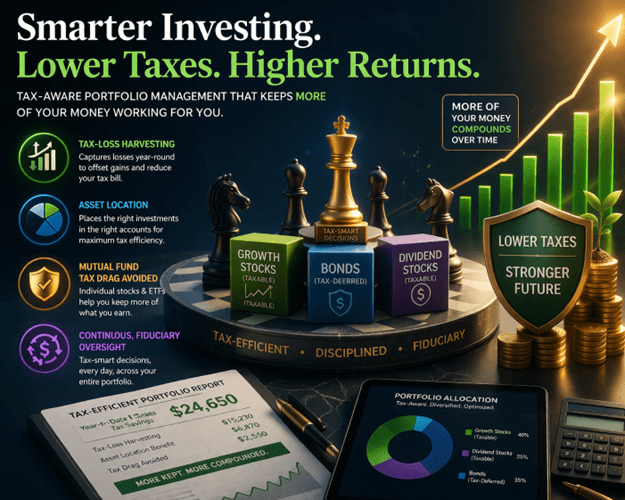
The True Advantage: Active Tax Management Within a Unified Strategy
A registered investment adviser (RIA) providing discretionary management doesn’t simply execute your investment ideas; they orchestrate a tax-aware investment strategy across your entire portfolio on a continuous basis. The distinction matters tremendously.
Tax-Loss Harvesting at Scale
The foundational tax strategy available through discretionary management is tax-loss harvesting—the systematic realization of investment losses to offset capital gains and ordinary income. However, the real power emerges when this strategy is deployed continuously throughout the year, not just during year-end planning.
When your portfolio holds individual securities—not mutual funds or ETFs—your investment manager can harvest losses opportunistically as market conditions create them. If a stock you own dips below its purchase price, your manager can sell that position, lock in the loss for your tax return, and immediately reinvest the proceeds into a similar (but not identical) security that maintains your desired portfolio allocation. The wash-sale rule prohibits repurchasing the exact same security within 30 days, but the universe of similar alternatives is vast: different companies in the same sector, different maturity bonds in the same credit quality range, and similar-duration municipal or corporate bonds with comparable economic characteristics.
The mathematics of this approach compound dramatically. Research indicates that continuous tax-loss harvesting using a daily rebalancing approach can generate approximately 30 basis points (0.30%) of additional annualized tax savings compared to monthly approaches. For a $2 million portfolio with a significant taxable component, that’s $6,000 in additional annual tax efficiency—pure preservation of wealth that would otherwise flow to the IRS.
More compelling still: approximately 75% of individual stocks experience a loss of more than 5% at some point during any given year. This creates systematic opportunities for loss harvesting that a skilled discretionary manager continuously monitors and executes.
Asset Location Strategy Across Multiple Accounts
Investors with investable assets exceeding $2 million typically maintain multiple account structures: taxable brokerage accounts, IRAs and other tax-deferred vehicles, and often spouse accounts or trust structures. A self-directed investor must manually ensure that each account aligns with the account’s tax status. A discretionary manager treats these accounts as an integrated system.
This coordinated approach is not simply organizational convenience—it generates measurable after-tax returns. Research examining portfolios managed using a coordinated asset-location strategy across multiple accounts found that such coordination generated additional after-tax returns generally between 0.05% and 0.25% annually, depending on portfolio composition and account structure. The highest impact occurred in portfolios with roughly 50% of assets in taxable accounts and 50% in tax-advantaged vehicles.
Here’s how this works in practice: taxable bonds that generate interest income—which is taxed at your full marginal ordinary income rate (potentially 37% for high-income earners in the highest federal bracket)—should be positioned in tax-deferred accounts like IRAs and 401(k)s where that income can compound without triggering annual tax liability.
Conversely, stocks that pay qualified dividends and growth stocks with low current distributions perform most efficiently in taxable accounts. Qualified dividends receive preferential tax treatment, with maximum federal rates of 0%, 15%, or 20% (plus potentially a 3.8% net investment income tax for high earners) depending on your taxable income—substantially lower than the ordinary income rates applied to bond interest. For 2026, investors filing jointly won’t pay any tax on qualified dividends if their taxable income is below $100,800, will pay 15% on qualified dividends with income between $100,801 and $614,350, and will pay 20% above $614,350.
This preferential tax treatment makes dividend-paying stocks with qualified dividends far more tax-efficient in taxable accounts than interest-bearing bonds, which face ordinary income rates that can reach nearly twice the qualified dividend rate for high-income investors.
A self-directed investor making these calculations manually may succeed occasionally. A discretionary manager makes these calculations systematically, across all accounts, continuously rebalancing and repositioning assets to maintain tax efficiency as market values shift and personal circumstances change.
The Hidden Costs of Mutual Funds and the Structural Advantages of ETFs Over Both
Many advisors default to mutual funds or exchange-traded funds (ETFs) as the foundation of portfolio construction. While these vehicles offer administrative simplicity and diversification, understanding their distinct tax characteristics—and their limitations compared to separately managed accounts of individual securities—is essential for investors managing substantial taxable assets.
The Mutual Fund Tax Problem
Mutual funds distribute capital gains annually to shareholders—often in December—generating tax liability whether you’ve received the economic benefit of those gains or not. Investors who purchased fund shares before the capital gain distribution date essentially receive a tax bill for gains earned by previous investors. Over time, this creates the phenomenon known as “tax drag,” where the fund’s after-tax returns substantially underperform pre-tax results.
The data is stark: research examining equity mutual funds over two decades found that the median tax burden for taxable fund investors exceeded 1.12% annually. That’s a permanent, structural drag on returns that exists independent of market performance. Funds in the highest tax-burden decile accumulated to roughly $37,850 after taxes on an initial $10,000 investment, compared to $48,818 for equivalent investments in the lowest tax-burden funds.
Why ETFs Are More Tax-Efficient Than Mutual Funds
ETFs address the mutual fund tax problem through a unique structural mechanism: in-kind redemptions. When an ETF experiences net selling pressure, authorized participants (specialized institutional traders) can redeem their ETF shares by receiving the underlying securities “in-kind”—as actual shares of stock rather than cash—rather than forcing the ETF to sell securities for cash.
This in-kind redemption process provides two significant tax advantages. First, it allows ETF managers to remove shares from circulation during periods of net redemptions without selling underlying securities and triggering taxable capital gains for remaining shareholders—the exact problem that plagues mutual funds. Second, when constructing the basket of securities to transfer out during in-kind redemptions, ETF managers strategically select shares with the lowest cost basis first, effectively increasing the average cost basis of remaining positions and reducing unrealized gains within the fund.
The result is dramatic: even during 2022, when the S&P 500 declined 18.1%, more than 42% of all active mutual funds still distributed capital gains worth an average of 5% of net asset value, while ETFs using in-kind redemptions largely avoided these distributions.
For this reason, ETFs are substantially more tax-efficient than mutual funds and represent a meaningful improvement for taxable investors who choose pooled investment vehicles.
Where ETFs Still Fall Short: The Case for Individual Securities
Despite their advantages over mutual funds, ETFs retain significant limitations compared to separately managed accounts holding individual securities—the approach employed for discretionary management of substantial portfolios.
Loss of Personalized Tax Management
The most consequential limitation is that ETF shareholders cannot harvest tax losses at the individual security level. When a stock within an ETF declines, that loss remains trapped inside the fund structure, benefiting all shareholders collectively through reduced unrealized gains but providing no immediate, personalized tax benefit to any individual investor. In contrast, when you own individual securities directly, your investment manager can sell specific positions that have declined, realize the loss on your tax return to offset gains elsewhere in your portfolio or up to $3,000 of ordinary income, and immediately reinvest in a similar security to maintain your investment exposure.
Research comparing these approaches found that tax-loss harvesting in separately managed accounts of individual securities can add 0.30% or more in annual after-tax value—benefit that simply doesn’t exist for ETF investors because they don’t control the individual securities.
Trading Costs: The Bid-Ask Spread
ETFs trade on exchanges throughout the day, and every purchase or sale involves a bid-ask spread—the difference between the price at which you can buy (the ask) and the price at which you can sell (the bid). This spread represents a transaction cost paid by investors each time they trade.
The magnitude varies substantially by ETF type. U.S. equity ETFs tracking major indexes typically show bid-ask spreads of 2–20 basis points (0.02%–0.20%), with median spreads around 9 basis points. However, spreads widen considerably for ETFs holding less liquid assets: emerging market equity ETFs often show spreads of 4–100 basis points with median spreads of 39 basis points, while high-yield bond ETFs range from 11–100 basis points with median spreads of 34 basis points.
For an investor trading a $100,000 position in an emerging market ETF with a 0.40% spread, the round-trip cost (buying and later selling) totals $400—before considering the expense ratio. These costs compound for investors who rebalance periodically or adjust allocations in response to market conditions or life changes.
In contrast, investors holding individual securities in a separately managed account typically face no bid-ask spreads on most large-cap stocks (which trade with spreads of mere pennies on share prices of $50–$200), and face smaller spreads on investment-grade bonds than the ETFs that hold those same bonds.
Forced Capital Gains Despite Tax Efficiency
While ETFs are far more tax-efficient than mutual funds, they are not tax-free. ETFs can and do distribute capital gains, particularly when the fund experiences significant redemptions that cannot be handled through in-kind transfers, when the fund must rebalance due to index methodology changes, or when underlying securities are acquired or reorganized. During volatile markets or structural changes to the ETF’s index, these distributions can become substantial.
Separately managed accounts eliminate this risk entirely. The only capital gains you realize are those your manager deliberately triggers as part of your personalized tax strategy—never because of other investors’ actions or index rebalancing requirements.
Limited Customization
ETFs provide “the same experience” to all investors: everyone owns the same basket of securities with the same weightings. If you wish to exclude certain companies for personal, ethical, or risk-management reasons, or if you hold concentrated positions in specific stocks that you want to avoid duplicating in your diversified portfolio, ETFs cannot accommodate these preferences.
Separately managed accounts allow complete customization. Your manager can exclude specific sectors, avoid individual companies, underweight positions you already hold through restricted stock or stock options, and align your portfolio with your values—while maintaining professional diversification and investment discipline.
Control and Transparency
When you own an ETF, you own shares of a fund that owns securities. When you own a separately managed account, you own the securities directly. This distinction provides both psychological comfort and practical advantages. You can see every security in your portfolio, understand precisely what you own, transfer those securities to another manager without triggering tax consequences, and maintain control even if you change advisors.
The Bottom Line on Structure
ETFs represent a substantial improvement over mutual funds for tax-conscious investors in taxable accounts. But for investors with $2 million or more in investable assets, the incremental tax efficiency, customization, loss-harvesting capabilities, and control provided by separately managed accounts holding individual securities justify the structure—particularly when managed by a fiduciary RIA who implements tax-aware strategies systematically across all accounts.
Strategic Rebalancing for Tax Efficiency
Market movements continuously shift your portfolio’s asset allocation away from your target strategy. After strong stock performance, equities might represent 65% of your portfolio rather than your target 60%. Traditional portfolio management suggests rebalancing: sell the outperformers (stocks) and buy underperformers (bonds) to restore your target allocation.
But rebalancing triggers capital gains taxes—a significant cost for taxable accounts. A discretionary investment manager approaching this challenge with tax awareness employs several alternatives:
New contributions first: If you have new cash available, allocate it to underweighted asset classes rather than selling appreciated positions. This restores your target allocation without triggering gains.
Dividend routing: Direct dividend and interest distributions from existing holdings into underweighted positions rather than reinvesting them proportionally.
Strategic timing: When rebalancing is necessary, realize losses on underperforming positions (which actually exist despite overall market strength) to offset the gains from rebalancing out of winners.
Tax-efficient transitions: If holdings must be sold in a tax-deferred account to acquire more efficient investments, execute those trades there rather than in taxable accounts.
These techniques sound straightforward in description. In practice, they require coordination across multiple account types, continuous monitoring of individual security positions and their tax status, and the discipline to execute strategies that may seem suboptimal on a pre-tax basis but generate superior after-tax results.
Strategic Tax Bracket Management
Income varies over time for many high-net-worth individuals—business owners experience variable income, executives receive substantial bonuses in certain years, real estate sales occur opportunistically. A discretionary manager working with your tax adviser can strategically time the realization of gains and losses to align with these income fluctuations.
During a low-income year or a planned gap in business activity, harvesting a significant embedded gain in a security—recognizing the capital gain immediately—may result in lower effective tax rates than allowing the appreciation to compound and realizing it in a year when income is higher and marginal rates consequently apply to that gain.
Similarly, Roth IRA conversions (where pre-tax IRA balances are converted to Roth status, triggering income tax now but allowing tax-free growth thereafter) can be perfectly timed when you have realized significant investment losses available to offset the conversion income. A discretionary manager’s ongoing harvest of losses throughout the year creates the optionality to execute these strategies efficiently.
The Professional Coordination Advantage
The most powerful element of discretionary management, however, extends beyond the specific techniques themselves. It’s the coordination and consistency of implementation.
Consider the tax-loss harvesting example again. A capable investor might harvest losses opportunistically a few times per year. But how will they ensure they don’t inadvertently repurchase the same security within 30 days, creating a wash sale and rendering their loss useless for tax purposes? How will they track cost basis across multiple accounts, custodians, and years to ensure capital gains are calculated correctly? How will they coordinate the timing of loss harvesting in the taxable account with distributions from their IRAs and the timing of other taxable events?
These aren’t theoretical concerns. Tax complexity increases exponentially as portfolio size and account complexity increase. The IRS has limited patience for honest mistakes, and the penalties for wash-sale violations, improper cost-basis calculations, and other tax filing errors can be substantial.
A registered investment adviser with fiduciary responsibility and comprehensive tax planning expertise brings systematic processes to these tasks. Tax-aware rebalancing protocols are documented and implemented consistently. Cost-basis tracking is automated and reconciled against custodial records. Wash-sale violations are prevented through institutional systems. Year-end tax planning reviews ensure that all opportunities have been captured and that the client’s overall tax position—not just the investment account—has been optimized.
In most cases, the after-tax returns generated through comprehensive tax planning exceed the investment management fees, fully offsetting the cost of professional services.
Who Benefits Most
These strategies are particularly valuable for investors in several specific situations:
High income earners: If you’re subject to federal tax rates of 32% or higher, the after-tax impact of investment decisions becomes paramount. Tax-efficient management directly translates to wealth preservation.
Concentrated positions: If significant portions of your portfolio are tied up in individual company stock—whether from executive compensation, inherited positions, or business founder status—tax-loss harvesting in surrounding positions can efficiently diversify the concentrated holding while minimizing tax consequences.
Multiple accounts: Coordinated management across taxable, tax-deferred, and tax-free accounts delivers substantially greater benefits than independent account management.
Regular income variability: Business owners, professionals with significant bonus components, or investors experiencing irregular income from investments or other sources gain particular advantage from strategic tax timing.
Long holding periods: If your investment approach emphasizes buy-and-hold discipline, a manager who can harvest losses without forcing premature sales of otherwise quality holdings delivers the best of both worlds: the portfolio strategy you believe in, with optimal tax management layered on top.
The Difference Between Theory and Practice
Reading about tax-efficient investment strategies is substantially different from executing them. A portfolio of individual stocks and bonds requires continuous monitoring: tracking cost basis, recognizing loss harvesting opportunities as they arise, coordinating across accounts, ensuring wash sales are avoided, and aligning the overall strategy with your specific tax circumstances.
More fundamentally, it requires viewing the portfolio as a unified system rather than a collection of individual accounts. When your investment manager can move seamlessly between your taxable account, your spouse’s IRA, your trust, and your brokerage account—coordinating which securities live in which accounts based on their tax characteristics—the tax efficiency of the overall system improves dramatically.
This is what truly independent, fiduciary-oriented discretionary investment management delivers: not simply access to quality investment vehicles, but the professional expertise, systems, and coordinated execution to ensure that your after-tax returns—the money you actually keep and deploy toward your financial goals—are optimized within the bounds of your investment strategy and risk tolerance.
For investors committed to discretionary individual stock and bond management as an investment approach, professional tax-aware coordination isn’t an optional enhancement. It’s the foundation that transforms good investment principles into superior after-tax wealth accumulation.
Disclosures
This article is for educational purposes only and does not constitute investment, tax, or legal advice. Tax laws and regulations are complex and subject to change. The tax information presented in this article reflects current law as of 2026. You should consult with a qualified tax professional or CPA regarding the tax implications of any investment strategy.
The performance data, historical returns, and research findings cited in this article are from third-party sources believed to be reliable but are not guaranteed for accuracy or completeness. Past performance does not guarantee future results.