
By Jeffrey Barnett, Founder and Managing Principal, Fintegrity® LLC
April 2026
If you’re evaluating investment managers — whether for the first time or because your current arrangement isn’t working — you’ve likely seen firms present performance numbers. A chart going up and to the right. A table showing they “outperformed.” Maybe a comparison to the S&P 500.
What you probably haven’t asked is: Who checked those numbers?
That question matters more than most investors realize. And the answer, in the vast majority of cases, is: nobody.
The Problem with Unverified Performance
The investment management industry has a credibility gap when it comes to reported returns. There is no law requiring an investment adviser to have their performance numbers audited or independently verified before showing them to you. The SEC requires advisers not to make false or misleading statements, but that is a prohibition — not a verification process. No one from the government reviews a firm’s track record before they put it on a website or slide into a pitch deck.
This creates an environment where the numbers you’re shown during a prospective meeting may be accurate, somewhat accurate, or carefully constructed to tell a flattering story. Common practices that distort the picture include:
- Cherry-picking accounts. Showing the best-performing client portfolios while omitting the rest.
- Selective time periods. Starting a track record at a convenient low point or ending it at a market peak.
- Gross-of-fee returns. Presenting performance before deducting the fees you’d actually pay — which can overstate results by 1% or more annually.
- Inconsistent benchmarks. Comparing a conservative balanced portfolio to a bond index when it outperforms, and to an equity index when that tells a better story.
- Survivorship bias. Quietly discontinuing a strategy that underperformed and removing it from the historical record.
None of these practices are necessarily illegal. But they make it effectively impossible for you to compare one firm’s reported performance against another’s with any confidence that you are looking at the same thing.
What the GIPS Standards Are
The Global Investment Performance Standards — known as GIPS — were created by the CFA Institute to solve exactly this problem. They are a set of voluntary, ethical standards that govern how investment firms calculate, present, and report their performance results.
The key word there is standardized. When a firm claims compliance with the GIPS standards, it has committed to a specific, globally recognized framework that dictates:
- How returns are calculated. Time-weighted returns using consistent methodologies, so that client cash flows in and out of an account don’t artificially inflate or deflate the reported result.
- How accounts are grouped. All discretionary, fee-paying accounts managed to a similar strategy must be included in a “composite.” A firm cannot exclude its worst-performing accounts from the record.
- What must be disclosed. Benchmarks, fee structures, the number of accounts in each composite, the dispersion of returns across those accounts, and the total assets the firm manages — all presented in a standardized format.
- What time periods must be shown. A minimum of five years of annual performance (or since inception, if the firm is younger), building to ten years over time. No starting the clock at a convenient moment.
In short, GIPS compliance means a firm has agreed to play by a uniform set of rules that prevent the most common ways performance numbers get distorted. It is the equivalent of requiring every company’s financial statements to follow GAAP — a common language that allows genuine comparison.
What Verification Adds — and What It Does Not
Claiming GIPS compliance is one thing. Having that claim independently verified is another. But it is equally important to understand the precise scope of what verification covers.
GIPS verification is a process in which an independent third party — typically a specialized performance measurement firm — assesses whether the firm has established policies and procedures for complying with the GIPS standards related to composite and pooled fund maintenance, and the calculation, presentation, and distribution of performance, and whether those policies and procedures have been implemented on a firm-wide basis. The verifier conducts this assessment through testing performed on a sample basis, along with any other procedures the verifier considers necessary.
Here is what that means and does not mean:
- Verification is not a full audit of every performance number. The verifier tests the firm’s processes, procedures, and a sample of the underlying data. It does not independently recalculate every return for every account in every period. A separate engagement called a “performance examination” can be conducted on specific composites to provide that deeper level of assurance, but performance examinations are not part of standard verification and were not performed for Fintegrity.
- Verification does not provide assurance on any specific performance report. As The Spaulding Group’s report for Fintegrity explicitly states: “This report does not relate to or provide assurance on any specific performance report of the Firm or on the operating effectiveness of the Firm’s controls or policies and procedures for complying with the GIPS standards.”
- The firm’s management remains responsible for its own claim of compliance. The verifier provides an independent opinion, but the obligation to comply sits with the firm itself.
Think of it this way: GIPS compliance is a promise. Verification is an independent assessment that the promise is backed by properly designed and implemented processes — but it is not a guarantee that every individual data point has been audited.
Verification is also performed at the firm level, not for individual composites or strategies. When a firm has been verified, the verifier has assessed the firm as a whole. This is a deliberate feature of the standards — it prevents a firm from seeking verification only for its best-performing strategy while ignoring the rest.
At Fintegrity, we have been independently verified on a firm-wide basis by The Spaulding Group, one of the most recognized names in investment performance measurement. That verification covers the periods from January 22, 2019 through December 31, 2025.
What this means in practical terms is that an independent firm has reviewed our policies and procedures for maintaining composites, calculating returns, and presenting performance — and has concluded, based on sample testing, that those policies and procedures are designed in compliance with the GIPS standards and have been implemented on a firm-wide basis. It provides a meaningful layer of credibility beyond a self-reported claim of compliance, even though it is not an audit of every number in every report.
How Rare This Is
Here is where the competitive landscape becomes relevant.
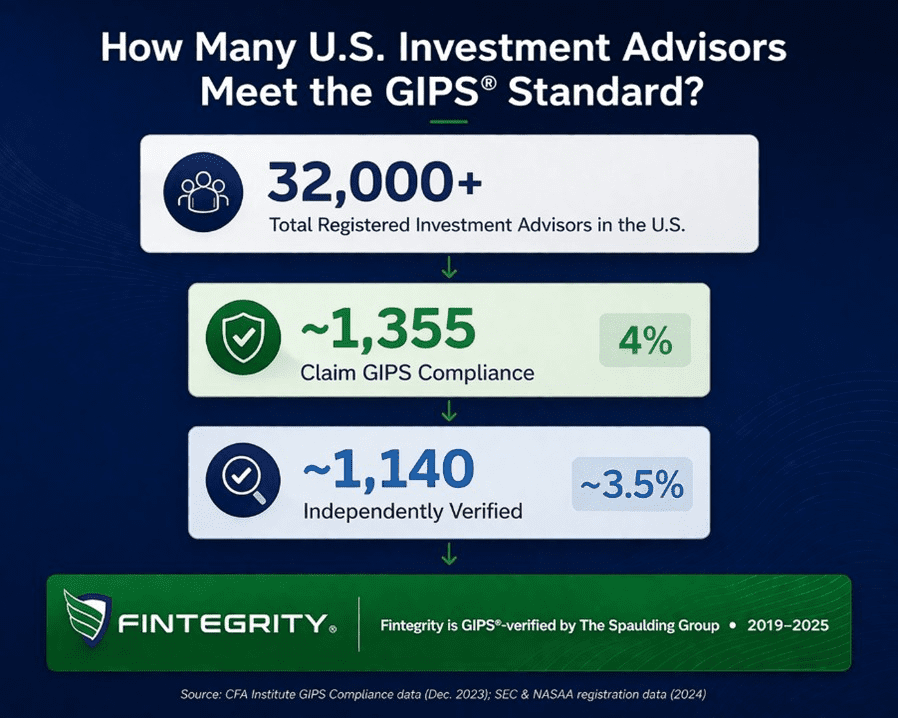
According to data from the CFA Institute, approximately 1,355 firms in the United States claimed compliance with the GIPS standards as of the end of 2023. The total number of registered investment advisers in the U.S. — both SEC-registered and state-registered — exceeds 32,000. That means roughly 4% of investment advisory firms in this country have committed to GIPS-compliant performance reporting.
Among those that claim compliance, about 84% have taken the additional step of engaging an independent verifier. That brings the number of U.S. firms with verified GIPS compliance to approximately 1,140.
The reasons for this low adoption rate are straightforward. GIPS compliance requires significant infrastructure — performance measurement systems, documented policies and procedures, consistent composite maintenance, and ongoing monitoring. Verification adds the cost and time of engaging a qualified third-party firm to review all of it. For many advisory firms, especially those that outsource investment management to third-party model providers or that do not make discretionary investment decisions, the investment in GIPS compliance may not make sense.
But for a firm like Fintegrity — where I personally research, select, and manage the individual stocks and bonds in every client portfolio — GIPS verification is a natural extension of the commitment to transparency and accountability. If I am going to make active investment decisions with your capital, I should be willing to subject my processes and reported results to independent scrutiny.
How GIPS Differs from SEC Requirements
Prospective clients sometimes assume that because their adviser is regulated by the SEC or a state securities authority, the performance numbers they see have already been vetted by a regulator. That assumption is understandable but incorrect.
The SEC’s Marketing Rule, updated in 2022, does impose requirements on how investment advisers advertise performance. Advisers must present net-of-fee returns, include relevant time periods, and avoid materially misleading statements. These are meaningful protections. But the Marketing Rule operates as a set of guardrails — it defines what advisers cannot do, not a standardized methodology for what they must do. Two firms can both be fully compliant with the Marketing Rule while calculating, grouping, and presenting their returns in materially different ways.
GIPS goes further. It prescribes a single, uniform methodology. Every compliant firm calculates returns the same way, groups accounts by the same rules, discloses the same data points, and presents results over the same required time periods. The Marketing Rule asks: “Is this advertisement misleading?” GIPS asks: “Can this performance record be fairly compared to any other compliant firm’s record, anywhere in the world?”
They serve different purposes, and a firm serious about transparency should comply with both. But only GIPS provides the standardization that makes an apples-to-apples comparison genuinely possible.
What to Ask Any Manager You Are Evaluating
Whether or not you ultimately choose to work with Fintegrity, I would encourage you to ask the following questions of any investment manager who presents performance numbers to you:
“Are your performance results GIPS-compliant?” If the answer is no, ask why. There may be a legitimate reason — perhaps they do not manage discretionary portfolios, or they are newly established. But if a firm has been managing money for years and has not adopted the industry standard for performance reporting, that tells you something about their commitment to transparency.
“Have you been independently verified?” Compliance without verification is entirely self-reported. Verification means an independent party has assessed the firm’s processes and tested a sample of the underlying data. Ask who the verifier is, what periods are covered, and whether any performance examinations have been conducted on specific composites.
“Can I see your GIPS composite report?” A compliant firm is required to make every reasonable effort to provide this document to prospective clients. It will show you annual returns net of fees, the benchmark used, the number of accounts in the composite, the dispersion of returns, and total firm assets. This single document gives you more reliable information about a firm’s investment results than most pitch decks contain in their entirety.
“Are the returns shown net of your fees?” GIPS requires firms to present net-of-fee returns. If a firm is presenting gross returns without making that clear, it is a red flag regardless of GIPS status.
“How are your composites constructed?” In other words, which accounts are included and why? A GIPS-compliant firm will have documented, consistent criteria for composite inclusion. A non-compliant firm may be making subjective decisions about which accounts to show you.
Why This Matters for Your Due Diligence
If you are entrusting someone with discretionary authority over your family’s wealth, you are placing significant trust in their judgment, discipline, and integrity. Performance reporting is one of the few areas where that trust can be objectively verified — not with a handshake or a reassuring conversation, but with standardized data reviewed by an independent party.
The financial services industry is full of confident storytellers. GIPS verification does not tell you whether a manager will outperform in the future — no standard can promise that. And it is not a full audit of every number in every report. But it does tell you that an independent party has assessed the firm’s processes for reporting performance and found them to be properly designed and implemented. Combined with the standardization that GIPS compliance itself provides, verification gives you a materially stronger basis for trusting a firm’s reported track record than you would have otherwise. In an industry where that kind of accountability is genuinely rare, it matters.
Fintegrity LLC claims compliance with the Global Investment Performance Standards (GIPS®). GIPS® is a registered trademark of CFA Institute. CFA Institute does not endorse or promote this organization, nor does it warrant the accuracy or quality of the content contained herein. To obtain GIPS-compliant performance information for Fintegrity’s strategies, or to request a GIPS Composite Report, please contact Jeffrey Barnett at Jeff@Fintegrity.com or 201-266-6829.
Jeffrey Barnett is the founder and Managing Principal of Fintegrity LLC, a registered investment adviser based in Tenafly, New Jersey. Fintegrity has been verified firm-wide by The Spaulding Group for the periods January 22, 2019 through December 31, 2025.
Fintegrity is registered with the New Jersey Bureau of Securities. This article is for informational purposes only and does not constitute investment advice. Past performance is not indicative of future results. All investments involve risk, including possible loss of principal.