
By Jeffrey Barnett, Founder and Managing Principal, Fintegrity® LLC
April 2026
If you have been thinking about changing advisors, you are probably not stuck on the “should I?” question. You already know the answer. What may be holding you back is the “how?” — the mechanics of actually moving accounts that have been at the same firm for years, with tax lots, cost basis history, retirement accounts, and positions you do not want to sell.
That anxiety is normal. According to the 2025 Janus Henderson Investor Survey, 89% of affluent investors work with multiple financial institutions, and 67% of those who do say they see no reason to consolidate — not because they are satisfied, but because the perceived complexity of moving feels like a barrier.
This article is meant to remove that barrier. The transfer process is straightforward, well-regulated, and designed to move your investments without selling them. Here is exactly how it works.
The ACATS System: Moving Investments Without Selling Them
The Automated Customer Account Transfer Service — ACATS — is the industry-standard system for transferring brokerage accounts between firms. It is governed by FINRA Rule 11870, which requires firms to complete transfers within specific timeframes and prohibits unnecessary delays.
The most important thing to understand about ACATS is this: your investments transfer in-kind. That means the shares of stock, bonds, and ETFs you own at your current firm move directly to your new firm. Nothing is sold. No capital gains are triggered. No taxable event occurs. The 500 shares of Microsoft you owned on Monday are the same 500 shares in your new account by the end of the following week — with their original purchase dates and cost basis intact.
The Timeline: What Happens and When
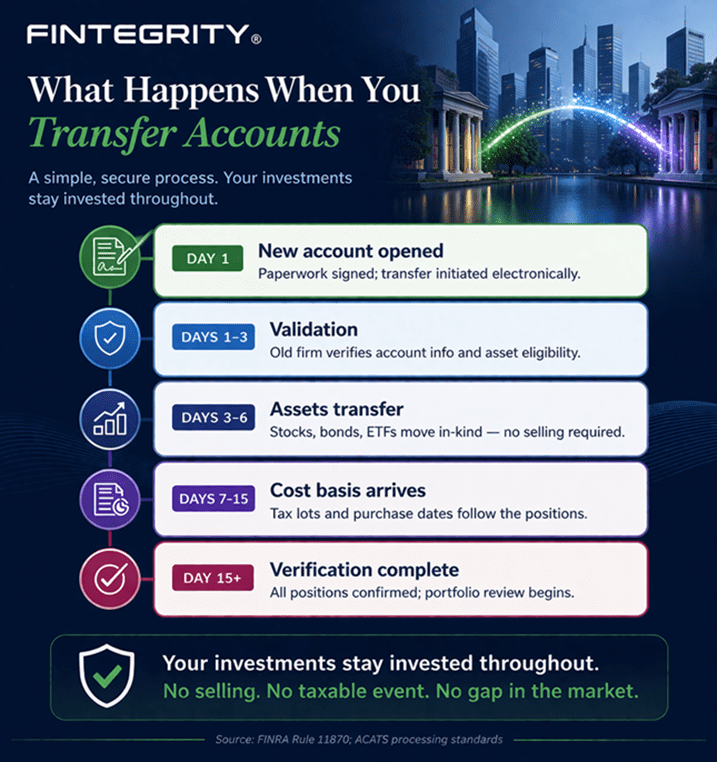
Day 1 — Account opening and transfer initiation. The process begins at the new firm, not the old one. You open your account and provide a recent statement from your current firm (within 60 days). Then, your adviser directs the new custodian to submit the transfer request electronically through ACATS. You do not need to contact your old firm, get their permission, or send them a letter. The system handles the communication.
Days 1 through 3 — Validation. Your current firm has one to three business days to validate the transfer request. They verify that the account information matches and that the assets you want to transfer are eligible. If everything checks out, they approve the transfer. If there is a discrepancy — for example, the account name does not match exactly — they will reject it with a reason code, and the new firm will work with you to resolve it.
Days 3 through 6 — Asset transfer. Once validated, the actual transfer of securities typically completes within three to six business days. Your positions move electronically from one custodian to the other. During this window, your account is temporarily frozen — you cannot trade the positions while they are in transit. For most investors, this brief pause is uneventful.
Days 7 through 15 — Cost basis delivery. Your positions arrive first. Your cost basis information — the purchase dates, prices, and tax lot details for every position — follows within approximately 15 business days. This is a separate data transmission from the delivering firm. I recommend verifying the cost basis against your own records once it arrives, particularly for positions acquired through employee stock purchase plans, reinvested dividends, or multiple purchases over time.
Day 15 onward — Verification and portfolio review. Once all positions and cost basis data have arrived and been verified, we conduct a comprehensive portfolio review. This is where the real work begins — evaluating what you own, what should be retained, what should be repositioned, and how the portfolio should be structured going forward.
What Transfers Easily — and What Requires Attention
Stocks, bonds, and ETFs transfer seamlessly through ACATS. These represent the majority of most portfolios and move without complication.
Mutual funds transfer if the receiving custodian supports the same fund. Most broadly available mutual funds transfer without issue. However, proprietary funds — those created by and available only through your current firm — cannot transfer. These will need to be sold before or after the transfer, which may trigger a taxable event. We evaluate this in advance and plan for it.
Options positions can transfer through ACATS, but timing matters. Do not initiate a transfer within two weeks of an expiration date. Most firms will not transfer options expiring within seven business days, and you will lose the ability to trade them during the transfer window. We review any open options positions before starting the process.
Restricted stock and company shares with transfer restrictions — such as shares from an employer equity plan or Rule 144 restricted securities — may not be transferable through ACATS. These often must remain at the current custodian or be transferred through a separate process. We identify these in advance so there are no surprises.
Retirement accounts (IRAs, Roth IRAs) transfer through ACATS just like taxable accounts. The process is the same, and there is no tax consequence — it is a trustee-to-trustee transfer, not a distribution. If you are transferring from a 401(k), that is a rollover rather than an ACATS transfer and follows a different process, which we handle as well.
Fractional shares typically cannot transfer. If you own 100.37 shares of a stock, the 100 whole shares transfer and the 0.37 fractional share is liquidated by your current firm and the cash follows.
How Tax Lots and Cost Basis Transfer
This is the question that causes the most anxiety, and understandably so. If you have held positions for years, your cost basis records are valuable — they determine how much tax you owe when you eventually sell.
Under IRS regulations, firms are required to transfer cost basis information for “covered securities” — generally, any security acquired after specific dates (2011 for most stocks, 2012 for mutual funds and ETFs, 2014 for certain bonds and options). For these securities, the cost basis transfer is automated and reliable.
For “non-covered securities” — positions acquired before those dates — the transfer of cost basis is not required but is often provided. If it is not, you can supply the information manually to your new custodian using your own records or historical statements.
At Fintegrity®, we verify every tax lot after a transfer is complete. If something does not look right, we research it and correct it before making any portfolio decisions that depend on cost basis accuracy. This step is not optional — it is essential for proper tax management going forward.
What a Good Onboarding Looks Like
The transfer itself is a mechanical process. What distinguishes a good transition is what happens around it.
Before the transfer, we conduct a detailed review of your current holdings, tax situation, and financial goals. This allows us to identify in advance any positions that may need special handling — concentrated stocks, proprietary funds, options near expiration, or restricted securities. We also discuss your priorities: are there positions you want to keep? Losses you want to harvest? Tax obligations that affect timing?
During the transfer, we monitor the process daily and communicate with you if any issues arise. Most transfers complete without incident. When they do not — a name mismatch, a rejected asset, a delayed cost basis — we resolve it promptly because we have anticipated the possibility.
After the transfer, we conduct a comprehensive portfolio review. This is not a cursory glance at asset allocation. It is a position-by-position analysis: What is each holding? What is the investment thesis? What is the cost basis and holding period? Does this belong in your portfolio going forward, or is there a better use of that capital? This review typically takes one to two weeks and forms the foundation of our ongoing management of your wealth.
Practical Tips for a Smooth Transfer
- Turn off automatic investments and dividend reinvestment at your current firm before initiating the transfer. Pending transactions during a transfer can cause delays or complications.
- Allow all recent trades to settle before initiating. Stock trades settle in one business day (T+1). If you traded recently, wait for settlement to clear.
- Avoid year-end transfers. Initiating a transfer in late December can complicate tax reporting, as dividends or distributions during the transfer may appear on statements from both firms.
- Save your most recent statements. Your current firm’s final statement is your backup record for verifying that everything transferred correctly.
The Question Behind the Question
In my experience, the real barrier to moving accounts is rarely the mechanics. It is the emotional weight of making a change. You may feel a sense of loyalty to a firm that has held your accounts for years, even if the relationship is no longer serving you well. You may worry that the process will be disruptive, or that something will go wrong, or that you will end up worse off than where you started.
Those concerns are understandable. But the transfer process is designed to be seamless precisely because regulators recognized that investors should be able to move freely between firms. FINRA Rule 11870 exists for this reason. Your old firm cannot refuse or unreasonably delay the transfer. Your investments remain invested throughout. And the cost basis that tracks your tax obligations follows your positions to the new account.
The hardest part is the decision. The mechanics are the easy part.
Jeffrey Barnett is the founder and Managing Principal of Fintegrity LLC, a registered investment adviser based in Tenafly, New Jersey. Fintegrity manages portfolios for high-net-worth families nationwide using individual stocks and bonds, with custody at Interactive Brokers. For more information or to discuss a potential account transfer, contact Jeff@Fintegrity.com or 201-266-6829.
Fintegrity is registered with the New Jersey Bureau of Securities. This article is for informational purposes only and does not constitute investment advice. Past performance is not indicative of future results. All investments involve risk, including possible loss of principal.