
By Jeffrey Barnett, Founder and Managing Principal, Fintegrity® LLC
A Century of Data
The S&P 500 index has returned roughly 10% per year, on average, since 1926. That single number is one of the most cited statistics in all of investing. It is also one of the most misunderstood.
One hundred calendar years of market data—from 1926 through 2025—give us an extraordinarily rich record. Wars, recessions, pandemics, technological revolutions, financial crises, and long stretches of prosperity are all embedded in that century of returns. The data tell a story that every serious investor should internalize: the long-term trajectory of the U.S. stock market has been consistently, even remarkably, upward. But the path has never been smooth, and the “average” year almost never happens.
The Power of Compounding
A dollar invested in the S&P 500 at the beginning of 1926, with all dividends reinvested, would have grown to approximately $20,000 by the end of 2025. Expressed differently, $1,000 invested in 1926 would be worth over $20 million today. That represents a 10% average annual total return over the full century.
Adjusted for inflation, the picture is still compelling. That same dollar would be worth roughly $1,086 in 1926 purchasing power—a 7.2% annualized real return. In other words, even after accounting for the cumulative erosion of the dollar over a hundred years, a disciplined equity investor saw purchasing power multiply more than a thousandfold.
These figures assume something important: the investor stayed invested. Every dollar of dividends was reinvested. Every downturn was endured. Every temptation to sell during a panic was resisted. Compounding rewards patience, but it punishes interruption.
The “Average” Year Almost Never Happens
Here is where the 10% average becomes misleading. In only about 6 of the 100 calendar years from 1926 through 2025 did the S&P 500’s annual return land within 2 percentage points of that 10% average—meaning between roughly 8% and 12%. In the vast majority of years, the actual return was well outside that range, often by a wide margin, with no obvious pattern.
Some years delivered extraordinary gains: the index has returned more than 30% in a single year on multiple occasions. Other years were devastating, with losses exceeding 30%. The distribution of returns is far wider than most people expect, and understanding that dispersion is essential to maintaining composure when markets move sharply in either direction.
Roughly 25% of calendar years produced negative returns. That means an investor should expect, on average, to see a losing year about once every four years. If that frequency surprises you, it is worth recalibrating your expectations before the next downturn arrives.
Resilience Through Crisis
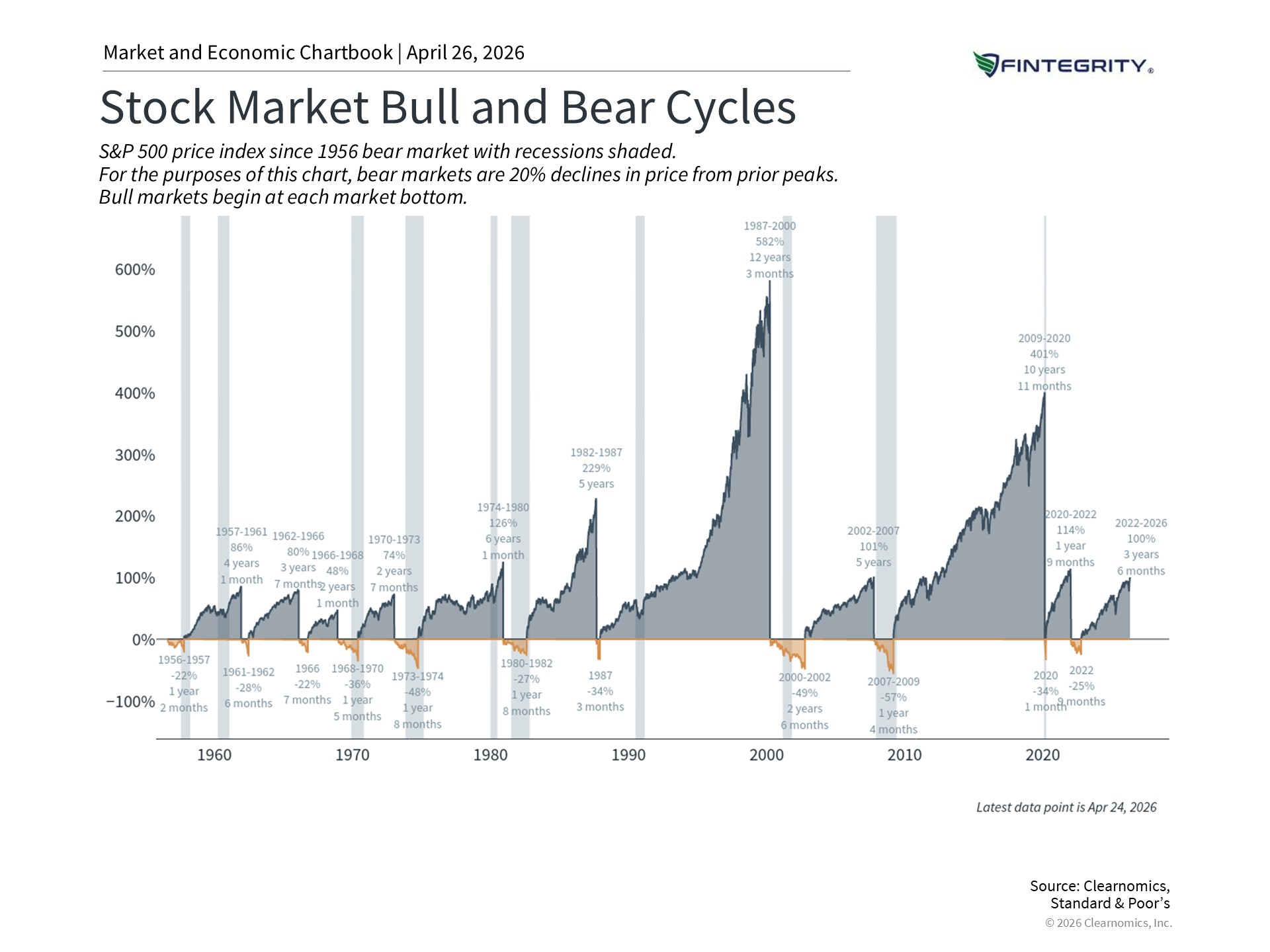
The century from 1926 through 2025 was not a period of calm. It encompassed the Great Depression, World War II, the Korean and Vietnam wars, the stagflation of the 1970s, the 1987 crash, the dot-com bust, the September 11 attacks, the 2008 global financial crisis, and the COVID-19 pandemic, among other disruptions. Each of these events tested investor resolve. Each generated headlines predicting lasting damage to markets.
And yet, the market recovered from every one of them. Good times have been disproportionately longer than the bad times. Bull markets have historically lasted years; bear markets, while painful, have tended to be measured in months. The duration of any given bull run has not been a useful predictor of what comes next. Markets do not expire from old age.
None of this means that losses are trivial or that recovery is guaranteed on any particular timeline. It means that for investors with a long horizon and a sound plan, history has consistently rewarded the discipline of staying invested.
The Practical Lesson
The most important takeaway from a century of stock market data is not the 10% average itself. It is the recognition that earning that return required enduring significant volatility along the way. The investor who captured the full compounding benefit of the S&P 500 was not the one who predicted each year’s direction. It was the one who remained invested through good years and bad.
Time in the market, not timing the market, is what builds wealth. This is not a slogan—it is an empirical observation supported by 100 years of data. The cost of being out of the market during even a handful of its best days is severe; those best days tend to cluster near the worst days, making it nearly impossible to capture the gains while avoiding the losses.
For investors with a well-constructed portfolio and a clear financial plan, the message from a century of returns is straightforward: stay disciplined, stay diversified, and let time do the heavy lifting.
For professional management of your investment portfolio, contact Jeffrey Barnett.
jeff@fintegrity.com | 201-266-6829 | www.fintegrity.com
This article is for informational purposes only and does not constitute investment advice. All investments involve risk, including possible loss of principal. Past performance does not guarantee future results. Fintegrity LLC is a registered investment adviser regulated by the New Jersey Bureau of Securities.