
By Jeffrey Barnett, Founder and Managing Principal, Fintegrity LLC
Updated April 2026
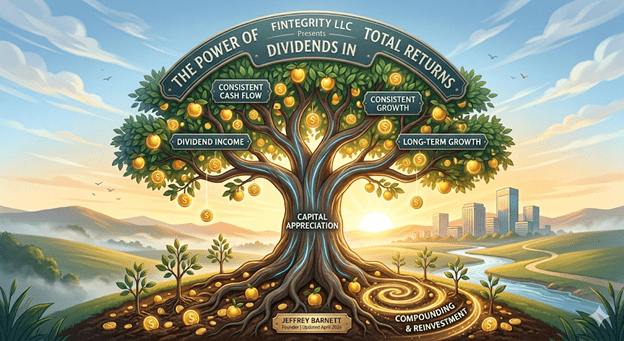
Dividends and Their Importance
Dividend income is often a signal of a company’s financial health and stability. Companies with a history of consistent dividend payments are typically well-established, profitable, and less susceptible to the worst effects of market volatility. This stability makes dividend-paying stocks attractive to income-seeking investors who rely on the steady stream of cash to meet financial needs or to reinvest for compounded growth.
The Role of Dividends in Total Returns
Total returns consist of two components: capital appreciation (the increase in stock price) and dividend income. To understand how much dividends have contributed to total returns, we need to examine their impact on both broad market indices and individual stocks.
According to S&P Global, dividends have contributed approximately 32% of the S&P 500’s total return since 1926, while capital appreciation has accounted for the remaining 68%. This is a long-term historical figure that has remained remarkably stable across different measurement periods. In some decades, dividends have been even more critical. During the 2000s — a period characterized by two significant market downturns and negligible price appreciation — dividends accounted for approximately 80% of the S&P 500’s total return.
The advantage extends to individual stocks as well. According to Ned Davis Research, dividend-paying stocks in the S&P 500 outperformed non-dividend-paying stocks by an average of 1.9 percentage points per year over the period from 1972 to 2020. Nearly five decades of data make this one of the more durable findings in equity research.
The Current Interest Rate Environment
For four decades, declining interest rates made dividend-paying stocks an increasingly attractive income alternative. As bond yields fell, investors who needed cash flow from their portfolios naturally gravitated toward equities that offered meaningful dividends.
That dynamic shifted meaningfully in 2022 and 2023, when the Federal Reserve raised rates aggressively to combat inflation, bringing fixed-income yields to their highest levels in over 15 years. This has made bonds more competitive with dividend stocks for pure income generation. As of December 2025, the S&P 500 dividend yield stood at just 1.15%, well below the long-term average of approximately 1.80%.
However, dividend-paying stocks continue to offer something bonds cannot: the potential for both income growth and capital appreciation over time. A bond’s coupon is fixed at issuance, but a company with a strong balance sheet can raise its dividend year after year, providing a natural hedge against inflation. For investors with a multi-decade time horizon, this distinction is significant.
Factors Supporting Dividend Strategies
1S&P Global, “Dividends, a Contribution to Total Return,”
https://www.spglobal.com/spdji/en/research/article/a-fundamental-look-at-sp-500-dividend-aristocrats/
2Ned Davis Research, Dividend-Paying Stocks vs. Non-Dividend-Paying Stocks, 1972-2020.
3Federal Reserve Economic Data (FRED), Federal Funds Effective Rate,
https://fred.stlouisfed.org/series/FEDFUNDS
4S&P 500 Dividend Yield as of December 2025, multpl.com, https://www.multpl.com/s-p-500-dividend-yield
Several factors continue to support the role of dividends in investor portfolios:
Income in a changing rate environment. Even with higher yields available on fixed income, dividend-paying stocks remain relevant for investors who want income that can grow. Companies in the S&P 500 Dividend Aristocrats index have raised their dividends for at least 25 consecutive years, demonstrating the kind of durable income growth that bonds simply cannot match.
Demographic demand for income. The aging population, particularly the baby boomer generation now well into retirement, has sustained demand for income-generating investments. Dividend-paying equities offer a way to participate in market growth while generating regular cash flow.
The power of reinvestment. Investors who reinvest their dividends benefit from compounding — one of the most reliable forces in long-term wealth creation. Over decades, reinvested dividends can represent the majority of a portfolio’s total value.
Conclusion
Dividend income has played a significant role in total returns for stock portfolios for nearly a century. Despite a higher interest rate environment that has given investors more options for generating income, the fundamental case for dividend-paying stocks remains intact: they offer a combination of current income, income growth, and capital appreciation that no single fixed-income instrument can replicate.
As the economic landscape continues to evolve, investors would be wise to consider the role of dividend-paying stocks in a well-constructed portfolio. The data spanning nearly a century makes the case clearly: dividends are not a secondary consideration, but a primary driver of long-term wealth.
At Fintegrity, we specialize in creating custom-tailored portfolios of individual securities, including a significant focus on dividend-paying stocks, adjusted to fit each client’s unique needs and investment goals. Contact us at 201-266-6829 to discuss how we can help build a portfolio designed to work for you.
This article is for informational purposes only and does not constitute investment advice. All investments involve risk, including possible loss of principal. Past performance does not guarantee future results. Fintegrity LLC is a registered investment adviser regulated by the New Jersey Bureau of Securities.